
TL;DR:
- Chat is a rapidly growing revenue stream for creators, transforming from a support tool into a profitable product. Effective monetization involves models like paid DMs, gated chat rooms, tipping, and hybrid approaches, supported by operational discipline and strategic platform selection. Prioritizing discovery and using layered models with AI assistance can significantly boost creator income and sustainability.
Most creators still think of chat as a way to keep fans happy. It is not. Chat is one of the fastest-growing revenue streams in the creator economy, and if you are not charging for it, you are leaving real money on the table. Understanding what is chat monetization, how it works across platforms, and which models fit your audience is the difference between a side income and a full business. This article breaks down every major format, pricing model, and implementation step so you can start generating revenue from the conversations you are already having.
| Point | Details |
|---|---|
| Chat is a revenue channel | Paid DMs and gated chat generate direct income, not just engagement or goodwill. |
| Multiple pricing models exist | You can charge per message, per session, or by subscription tier depending on your audience. |
| Hybrid models outperform single-stream | Combining tips, subscriptions, and ads generates more revenue than relying on one format alone. |
| Operational discipline matters | Transparent rules, consistent moderation, and clear pricing convert more fans into paying customers. |
| Cold-start is your first real obstacle | Without a discovery strategy, even well-designed chat monetization will struggle to grow. |
Chat monetization is the practice of generating revenue from direct conversations between you and your audience. Instead of treating messages as free support or casual interaction, you structure them as a product with real pricing and clear value.
The formats vary widely. Here are the most common ones:
Chat monetization fits squarely within creator monetization broadly, which covers every method a creator uses to convert audience attention into income. What makes chat unique is the personal, one-to-one (or small group) nature of the interaction. Fans pay specifically for your direct attention, not just your content.
Pro Tip: Think of your chat offering the way a consultant thinks about office hours. You have limited time, and that scarcity justifies charging for access to it.
Revenue is typically structured around three pricing units: per response (a flat fee per message), per session (a fixed price for a defined time window), or per tier (a monthly subscription that unlocks chat access as part of a package). Each has different economics and suits different audience relationships.
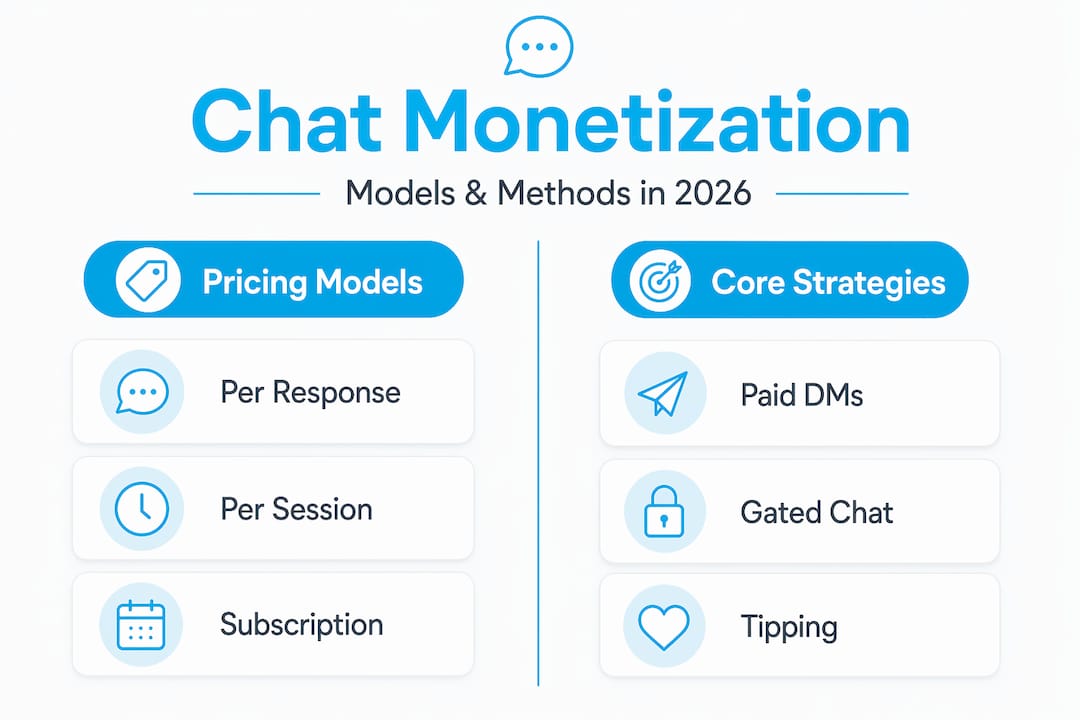
Once you understand the basics, the real question is which model fits your audience and goals. There is no single correct answer. Here is how the major frameworks compare:
| Model | Best For | Revenue Pattern | Risk Level |
|---|---|---|---|
| Paid DMs | Established creators with loyal fans | High per-unit, variable volume | Low |
| Gated chat rooms | Community-focused creators | Predictable, recurring | Medium |
| Tipping in live chat | Streamers and live video creators | Unpredictable, event-driven | Low |
| Hybrid subscription + ads | Scale-focused or app-based creators | Consistent + passive | Medium |
| Time-boxed sessions | Expert or niche creators | High per-session, limited capacity | Low |
The data behind hybrid models is hard to ignore. Combining ads and subscriptions generates 20 to 30% more revenue than single-model approaches for chat-based products. A subscription-only approach typically converts only 2 to 5% of your free audience. Adding an ad-supported free tier captures revenue from the remaining 95% who would never pay directly.
Here is a practical order for rolling out chat monetization if you are starting from scratch:
Platforms matter here too. OnlyFans pay-per-view messaging and Snapchat subscriptions are proven formats. Snapchat’s revenue-sharing model grew non-advertising creator revenue by 87% year-over-year in Q1 2026 by combining subscriptions and digital item sales. The right platform depends on where your audience already lives.
Pro Tip: Do not launch all models at once. Pick one, run it for 30 days, measure what fans actually pay for, and then expand. Spreading too thin too fast leads to poor execution across all formats.
Knowing the models is step one. Actually running them profitably takes operational discipline. Here is what you need to get right from the start:
The creators who build durable chat revenue treat it as a managed product. They review pricing, response rates, and conversion monthly. They know which message types convert into upsells and which ones are just noise. That level of attention is what makes chat a real income engine.

Even well-designed chat programs fail when creators make predictable mistakes. Knowing what to watch for saves you months of frustration.
The biggest operational error is over-commercializing too fast. If every message feels like a sales push, fans disengage. Your free interactions need to stay genuinely valuable so fans trust that your paid tier is worth the upgrade.
Spam and moderation issues compound quickly in monetized environments. Once you start charging for chat access, some users test the rules. Without clear moderation standards, the quality drops and paying fans leave. This is not a passive problem. You need proactive management from day one.
Revenue fluctuation is real, especially if you rely on a single model like tipping. Event-driven income swings are normal, but they become dangerous if you have no recurring base. Layering in a subscription element creates a floor that protects you when live stream activity dips.
The biggest barrier for smaller creators is the cold-start problem. Platforms that integrate discovery systems reduce external dependency and improve long-term retention significantly.
You cannot monetize a chat audience you do not have. If your platform has no built-in discovery, you need an external strategy to drive new fans into your chat funnel. Instagram, TikTok, and cross-platform marketing are not optional extras. They are how you feed the top of the funnel.
Pro Tip: Treat your chat management pricing model as a living document. Review it quarterly alongside your costs and user behavior. Rapid changes in costs and user patterns mean that what works in January may underperform by July.
Finally, do not build everything on one platform. Platform policy changes, algorithm shifts, and fee increases happen without warning. Spreading your chat revenue across two or three channels protects your business from a single point of failure.
I have worked with enough creators to say this plainly: the ones who treat chat as a product outperform everyone else. Not occasionally. Consistently.
What I have seen is that most creators approach chat monetization as an afterthought. They set up a paid DM link, mention it once, and then wonder why it barely moves the needle. The problem is not the model. It is the positioning. Creators who treat chat monetization as a core revenue engine outperform those who treat it as a secondary stream, particularly when they combine discovery with monetization.
What actually works, in my experience, is the stepping-stone approach. You guide fans from free engagement into a gated community, and from there into high-ticket personal sessions. Each step feels natural because the value increases at each level. No one feels pressured. They opt in because the offer makes sense at every stage.
I also think AI is reshaping this space faster than most creators realize. The creators layering AI-assisted chat tools into their workflow are handling five times the conversation volume without burning out. That is not a future trend. It is happening now. If you are still managing every chat manually, you are spending time on volume instead of on the relationships that drive real revenue.
The data supports layering multiple models rather than betting on one. Combine a subscription base with paid DMs and occasional time-boxed sessions. That stack gives you predictable recurring income, high-margin one-off revenue, and premium access pricing all at once. That is how you build something resilient.
— Gjon
Scaling chat monetization on your own is possible, but it is slow and exhausting. Only-dreams was built specifically to handle the operational side so you do not have to.
Only-dreams provides dedicated account managers and trained chat teams that build real relationships with your fans around the clock. The team handles moderation, message volume, upsell conversations, and pricing strategy while you focus on creating content. Creators working with Only-dreams have seen measurable improvements in both subscription retention and per-fan messaging revenue. Whether you are just starting with paid DMs or ready to build a full professional chat revenue system, the team at Only-dreams brings the structure, strategy, and execution to make it work at scale.
Chat monetization means generating revenue from direct conversations with your audience, through paid DMs, gated chat rooms, tipping, or time-boxed sessions. It treats fan interaction as a structured product rather than a free service.
Paid DMs currently range from $5 to $500 per message, and mid-tier creators who added them saw 30 to 70% increases in monthly revenue in 2025.
Tipping is the lowest friction starting point because it requires no gate or commitment from fans. Once fans are comfortable paying, you can introduce paid DMs and then a subscription-based gated chat.
Keep your free interactions genuinely valuable so fans understand the paid tier is an upgrade, not a paywall. Transparent pricing and moderation rules are the most effective tools for maintaining trust during the transition.
Without new fans entering your ecosystem, paid chat revenue stagnates. Platforms that integrate discovery reduce dependency on external traffic and improve long-term retention.